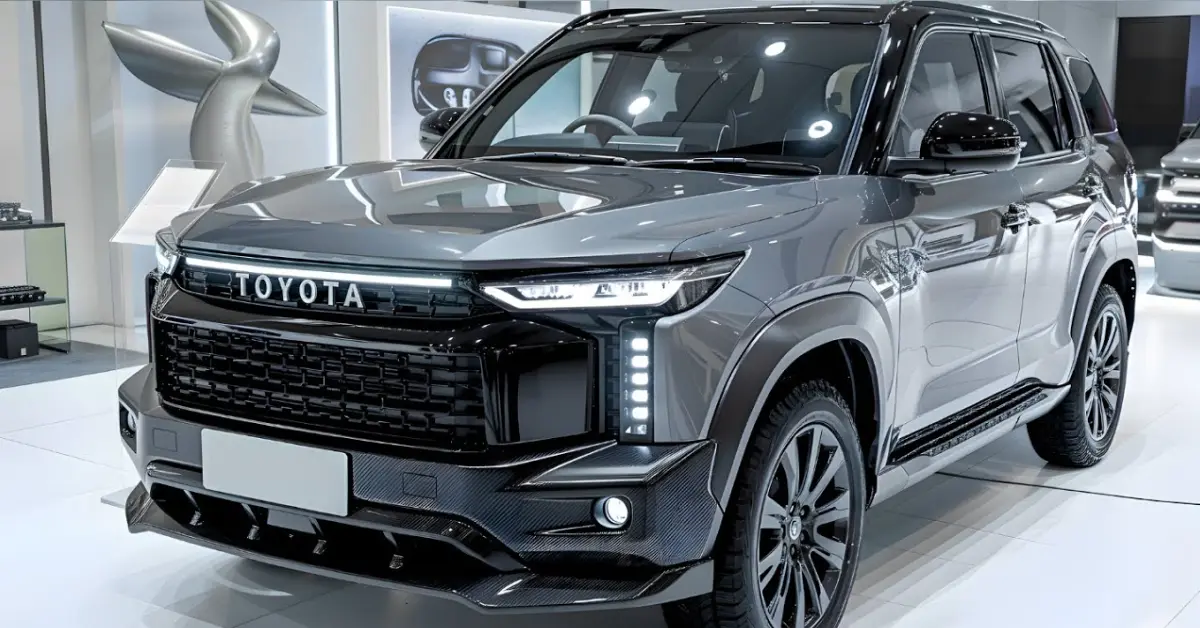
The Toyota Motor Corporation (Toyota) is also said to be developing another member of its iconic Toyota Land Cruiser family, a smaller and urban-friendly SUV which has a monocoque chassis. The next model will make the Land Cruiser DNA of durability, mountain-goat capability and brand name come in a smaller, more practical size. This new Land Cruiser, according to reports, could be a fresh start, one that will attract not only hardcore off-roaders, but also the urban adventurers and young buyers of SUVs.
Such a model would be a smart one considering the increased demand of compact SUVs in the emerging markets (such as India). We can take a closer look at what we have so far – and what this possible small Land Cruiser may bring.
Why a Monocoque Layout? – A Shift in Platform Strategy
Historically Land Cruiser cars have employed ladder-frame chassis – strong frames designed to support heavy off-roading and utility functions. The recently teased small Land Cruiser, however, will change: the model will likely be constructed on a monocoque platform, which will be a first in Land Cruiser history.
This architectural innovation is an indicator of a shift: a monocoke frame is more likely to provide less weight, comfort at the ride, and driving characteristics of a car – the characteristics that would favor urban streets and everyday use. With the combination of the Land Cruiser tradition and the contemporary platform architecture, Toyota appears to be targeting the use of a balanced SUV that can be used both in the streets and light off-road wilderness off-roading.
Size & Design: Small Yet Has Land Cruiser Soul.
Based on renders and official leaks, the smaller Land Cruiser will be a much smaller car even compared to the newly released Toyota Land Cruiser FJ. The new model can be positioned in the 4.3/4.4 m range – shorter than the length of FJ which is about 4.575 m.
On the height aspect, it might stand approximately 1,705 mm or about 165 mm less than higher Land Cruiser models such as the 250 series that makes it much easier to maneuver in urban areas.
In terms of concept images and sketches, design language is oriented to a modern and rough style: straight lines, body panels, small overhangs and SUV-ish appearance. This styling is a little less blocky and too rugged than the classic Land Cruiser silhouette–and appears to be aimed at the mainstream buyers of the SUV who wish it to be practical but infused with the off-road flair.
What Powers It? – Electric, Hybrid or ICE? All Options on Table
At this point, Toyota has not disclosed the official information regarding the powertrain. According to media speculation, the compact SUV may have alternative flavours of powertrain – maybe BEV (battery electric vehicle) or HEV (hybrid electric vehicle) in addition to the traditional ICE (internal combustion engine).
Remarkably, the concept version, presented above (as Land Cruiser Se) was a BEV. That leaves the possibilities open that would enable Toyota to appeal to urban consumers who seek environmental friendliness in their mobility without sacrificing on the utility of an SUV.
Simultaneously, due to the global approach of Toyota and the markets to which it will be delivered, a hybrid or an ICE variant appears to be a possibility – particularly in the areas where charging networks are not widely deployed yet. This multi-powertrain strategy would make the small Land Cruiser have wide appeal in the segments.
Who Is This For? — City Shoppers and Children of Young Families Adventurous.
The new monocoke compact Land Cruiser is not targeted at the same category of customers as the traditional Land Cruiser however; unlike the traditional Land Cruiser which is often powerful, heavyweight off-road monsters that are more appropriate in rough roads, the new model is smaller:
City residents or suburban residents who desire the appearance of an SUV and the strong SUV experience but in a smaller, urban-friendly format.
Young families or young couples that require utility – easy parking, good interior space (with clever packaging) and utility.
Never before SUV purchasers who like the Land Cruiser brand heritage and dependability, but do not require full-fledged off-roading.
Nature-friendly consumers (assuming that BEV/HEV models will be available) who need sustainability and SUV life.
In a nutshell: it is aimed at consumers who desire a lifestyle of Land Cruiser light – a car that is both heritage and practical in nature.
What It Implies to Markets such as India.
This new Land Cruiser may be a formidable competition to such markets as India, where compact and mid-size SUVs are very popular. The existing sub-4.5 m SUV category is already oversaturated and competitive; a new Land Cruiser label has the possibility to differentiate through brand heritage, construction and potentially hybrid/ev powertrain options.
Additionally, to buyers of full-size SUVs who find them costly, messy to maintain, or otherwise too huge to use in urban areas – this small Land Cruiser can occupy a special market niche.
When Toyota chooses to export it to India (which is one of the possibilities, which have been suggested by the news on the world launch) and packages it accordingly, it has a potential to attract another category of buyers who have long envied Land Cruisers but believed they are out of reach.
Difficulties and What Remains a Mystery.
Naturally, the questions are not answered:
Will Toyota make it priced in a manner competitive to the mass-market buyers or will the product be a niche, high-end product?
What will be its off-road capability – will it remain Land Cruiser tough or will there be compromises on performance in rough use?
Infrastructure and servicing in areas with scanty charging facilities: in case of an EV version, how will Toyota manage the situation?
How will the trade-offs be ground clearance, suspension robustness and durability over the traditional ladder-frame Land Cruiser?
The balance of these tradeoffs by Toyota will make or break this small Land Cruiser into a viable success or a project with restricted attractiveness.
Conclusions -Now the Land Cruiser Legacy deserves a Smart Reboot.
The suggested smaller, monocoque Land Cruiser SUV seems to be a clever, futuristically-minded move on the part of Toyota: it pays respect of the legacy and the nameplate, but it will adapt with the new times. It may provide the correct combination of utility, design and brand equity – perfect to the urban living, and still without compromising the fantasy SUV essence.
Assuming Toyota keeps its word compact size, versatile range of powertrain offerings, sleek looks and affordable price, this new Land Cruiser may well reinvent the “Land Cruiser” concept to the new generation.